
The advantages of smart wallets are obvious: they are smaller, more secure, and more functional than regular wallets.
December 19 2023 – Lore Uhl
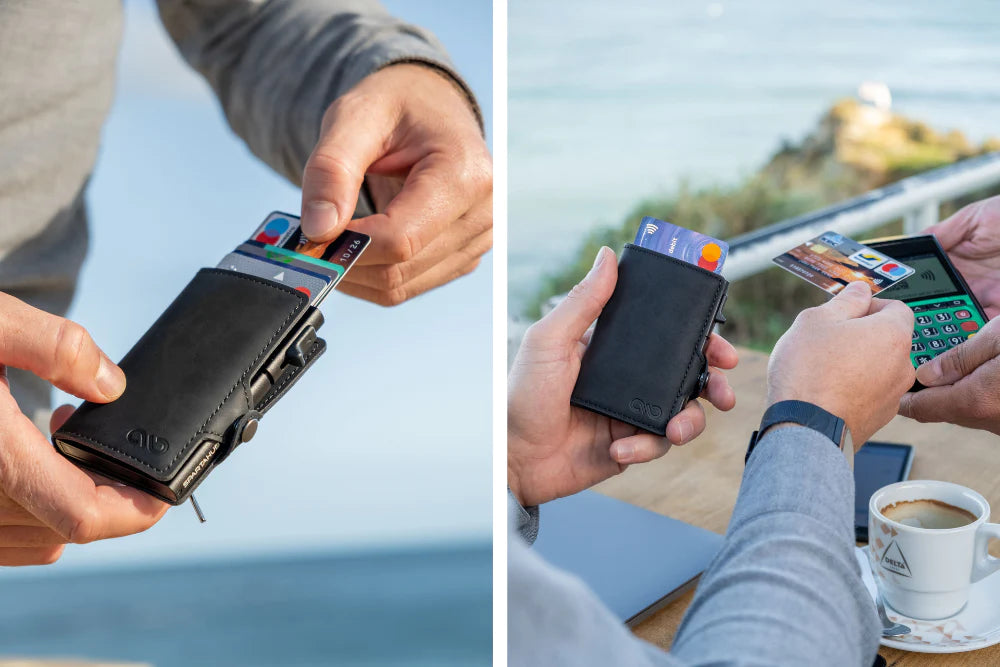
What is a smart wallet?
A smart wallet, also known as a smart purse, is exactly what the name promises: an intelligent wallet.
Traditional wallets primarily serve to store money and cards. However, while storing cash is becoming less important, storing cards is not necessarily the strength of conventional wallets.
Owners of traditional wallets often face the problem that they cannot find the required card or can only get it out of the slot with difficulty.
Smart wallets, on the other hand, are designed to keep your cards compact and secure.
But what exactly makes a smart wallet "smart" compared to a conventional wallet?
The main focus here is on the card pop-up mechanism. This mechanism allows you to get an overview of all your cards at the touch of a button.
The button mechanism pushes the cards out to make them more visible and easier to access, an aspect that conventional wallets often fail to address.
A smart wallet thus creates order precisely where other wallets reach their limits.
Thanks to the innovative card pop-up, you not only maintain a clear overview of your cards, but you can also have them readily available in seconds, saving time and frustration for you and those around you.
The innovation of the slim wallet with coin compartment in combination with an AirTag from Apple.

What truly makes this smart wallet unique, however, is the integration of the AirTag tracking function. The AirTag, an Apple product, is a small, slim device that uses GPS and Bluetooth to locate a lost Slim Wallet. Integrating this handy tool into the smart wallet is what makes it truly "smart."
The Smart Wallet with AirTag allows users to locate their wallet using Apple's "Find My" app. As soon as the wallet is lost, the AirTag sends out signals that can be detected by other nearby Apple devices. This allows the wallet's location to be pinpointed worldwide, making lost or stolen wallets a thing of the past. In 90% of cases, the wallet is returned to its owner.
Underestimated - What the loss of a wallet really costs

Losing your wallet isn't just an annoying mishap; it can also be quite expensive. From the obvious cost of replacing cards to the hidden expenses that are often overlooked, let's take a closer look at what losing a wallet can cost on average.
Card replacement:
The most obvious costs arise from replacing bank cards, credit cards, driver's licenses, and other identification documents. These are very expensive in this country, and the fees for reissuance quickly add up.
Cash loss:
We often carry a certain amount of cash in our wallets. Losing this cash means a direct financial loss.
Personal belongings:
Sometimes we keep small personal items like photos, gift cards, or keepsakes in our wallets. The loss of these personal items cannot be measured in money, but their emotional value can be very high.
Time & Stress:
The time spent dealing with a lost wallet cannot be underestimated. From dealing with government offices and making calls to banks to blocking cards – all of this is not only stressful but simply extremely annoying.
Identity theft:
A stolen ID opens the door to identity theft. Criminals could try to take out loans or carry out fraudulent transactions in your name. Dealing with identity theft can incur significant costs for lawyers and security services.
Conclusion:
Losing a wallet can very quickly lead to costs exceeding €500. In addition, it causes unnecessary stress and requires dealing with government offices.
To avoid unnecessary costs and risks, it's advisable to take precautions. Integrating technologies like smart wallets with tracking capabilities, such as our Smart Wallet with Airtag, can help prevent loss or at least quickly resolve the issue. All of this makes our Smart Wallet your practical everyday companion.
0 comments